Our High Availability (HA) clusters are server systems able to increase your network services continuity using redundancy techniques. They integrate the most advanced hardware and software technologies but still easy for users.
Our high availability cluster are based on open source software technologies integrated in the Linux HA project. Software includes the operating system (Linux), the middleware for High Availability (Heartbeat) and the network system (GFS, DRBD). It is possible to realise active/passive and active/active solutions, with the load sharing and active/active asymmetry. As an alternative it is possible to use Red Hat Cluster Suite technology or other commercial solutions.
We can work on servers provided by us or install and configure software directly on your machines. The servers that we propose are enterprise class equipped with ECC Registered RAM modules and SATA, SAS or SCSI hard-disks (single or in RAID), with chassis tower or for rack, equipped with single or redundant power unit. Optional IPMI module for remote control.
We use network filesystems that guarantee data integrity and synchronisation according to the HA architecture choice. In absence of sharing storage unit we use DRBD to maintain a synchronized data copy on each server. Otherwise we only use filesystem storage which guarantee the concurrent data access also in HA active/active modality (GFS, Oracle FS, ...).
Storage requirements can be satisfied using disk-arrays servers mounted and RAID configured, or external storage units (click here for more info). The external storage can be connected to the servers by ATAoE, iSCSI or Fiber Channel interfaces.
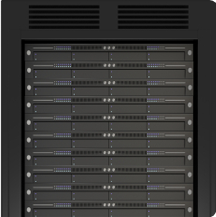
Servers are rack mounted (typically of 25 or 42 units) by sledge to facilitate their extraction. A structural cabling is important in order to have only electricity supply distribution cables and network cables out of racks. Frontal and back grids ensure the ventilation, optional forced ventilation systems can be provided.
A possible cluster protection against tension changes and blackout is possible through a UPS built in rack or external. The UPS allows to stabilize and filter the electrical signal, reducing server feeder damages, and allow to overcome short term blackout maintaining the cluster operative. In case of long term blackout the UPS makes a controlled shutdown of the cluster.
Our cluster systems are under a 2-year hardware warranty and under a 6 months remote software assistance. It is possible to extend the hardware warranty for 1 more year and with on-site NBD interventions (technician's intervention within 1 working day) and also to renew the software assistance through annual contracts or work-hour vouchers..