Home » Products » Cluster HPC

Cluster for HPC

Our High Performance Computing (HPC) are ready-to-use multiprocessor computing systems having all the necessary software. They integrate the most advanced hardware and software technologies and are easy to use.

  • High performances, thanks to the high computing power achievable by using computers in parallel and the best available hardware technologies on the market.
  • Turnkey solutions, thanks to a software platform which meets all customers' requirements for cluster-computing and which is ready for the installation and/or the development of customer's computing applications.
  • Easy to use, the system is integrated in the department network and appears to users as a single server; supporting all common access ways (file sharing, shell, Xserver browser, ...).
  • Costs Reduction, a cost reduction is possible thanks to an excellent price/performance ratio offered by Linux cluster technology, to carefully selected hardware products, and the use of free open source software.
  • Scalability is possible, starting with with systems with a low number of units and depending on customers' requirements increasing the number of nodes (up to hundreds nodes) with investments close to the numer of computers.
  • Flexibility, thanks to the high customisation capabilities of the open-source software given its wide range of software packages and documentation.
  • Assistance and support: at hardware level we provide assistance solutions extendible and personalised (2 years on-centre base), at a software level assistance is provide by our qualified technicians, and when it is possible a remote support is given in order to reduce time and costs.

Software

Our clusters are equipped with Aethia HPC Suite, the complete software set realized by Aethia based on standard technologies and open-source. Aethia HPC Suite includes the operating system (Linux), the middleware for cluster-computing (network filesystem, software images management, centralized user account, parallel administration), parallel filesystems, MPI libraries, optimized compilers, resource manager (queue and job scheduler), including libraries and tools for data elaboration and visualisation.
Alternatively, it is possible to ask for commercial management systems, as Windows HPC Server for example.

Systems

Front-end and computing nodes are developed through servers with 1, 2 or 4 quad-core processors, equipped with ECC Registered RAM modules and SATA, SAS or SCSI hard-disk (single or in RAID), chassis for rack with 1U or 2U form factor, equipped with single or redundant power unit. Optional remote control unit. TWIN systems are also available with a double motherboard bi-processor in 1U chassis.

Interconnection

Computing nodes interconnection can be made through standard technologies as Gigabit Ethernet (double interface at 1 Gbit/s on all nodes), or dedicated as Infiniband (up to 20 Gbit/s with very low latency). An interconnection overlap is possible, in order to split different type of network traffic (data, management, storage...).

Parallel Filesystem

In order to be able to use the hard disk space on the computing nodes in the best possible way, particularly as a scratch area, it is possible to configure distributed filesystems like Lustre or PVFS2, that allow high performance I/O (data striping on different unites contemporaneously) and to work on simple unique volumes and accessible to all nodes.

Storage

Storage requirements can be satisfied through disk-arrays RAID configured and front-end mounted, or through external storage units (click here for more info). The external storage can be connected only to the front-end for common data repository, or to all nodes to realise a high performance I/O, by ATAoE, iSCSI or Fiber Channel interfaces.

Consolle

The cluster is provided with a console consisting of LCD monitor, mouse and keyboard to simplify setup and maintenance. The console can be connected just to the front-end, or also to all computing nodes by an added switch KVM.

Rack

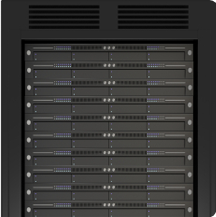
Cluster nodes are rack mounted (typically of 25 or 42 units) by sledge to facilitate their extraction. A structural cabling is important in order to have only electricity supply distribution cables and network cables out of racks. Frontal and back grids ensure the ventilation, optional forced ventilation could be provided as well.

UPS

A possible cluster protection against tension changes and blackout is possible through a UPS built in rack or external. The UPS allows to stabilize and filter the electrical signal, reducing server feeder damages, and allow to overcome short term blackout maintaining the cluster operative. In case of long term blackout the UPS makes a controlled shutdown of the cluster.

Warranties and assistance

Our cluster systems are under a 2-year hardware warranty and under a 6 months remote software assistance. It is possible to extend the hardware warranty for 1 more year and with on-site NBD interventions (technician's intervention within 1 working day) and also to renew the software assistance through annual contracts or work-hour vouchers.